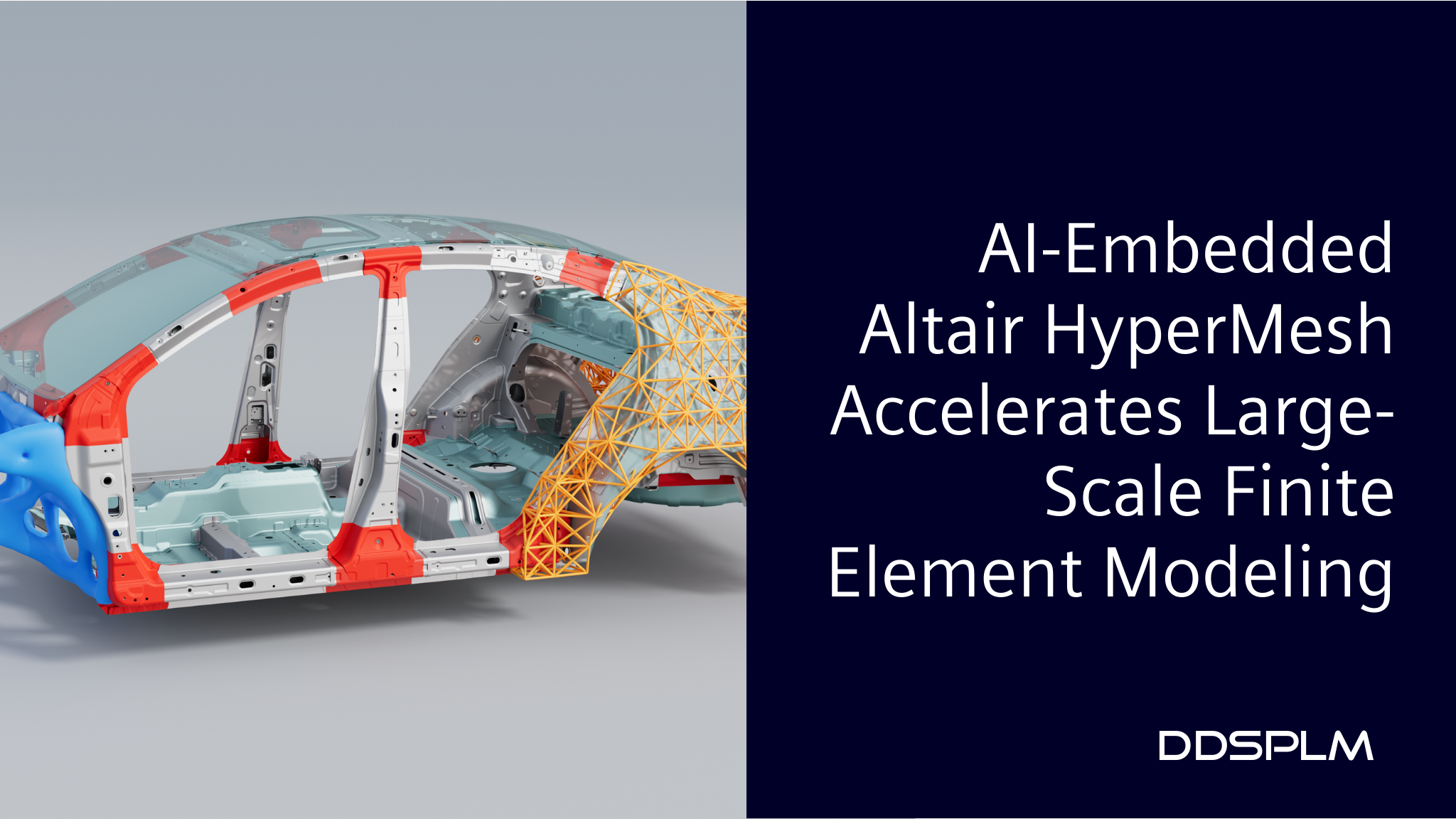
AI-Powered Finite Element Modeling and Analysis Software for Large Assemblies, Simulations, and Visualizations.
Altair HyperMesh FEA analysis software streamlines processes that set up, build, run, visualize, and analyze simulations of large geometries and assemblies. Its optimized, guided, and AI embedded workflows ensure model build and assemblies, solver setup, report generation, pre- and post-processing are all significantly faster with some benchmarked workflows speeding up from hours to minutes. Key features include the ability to build and manipulate geometry, meshes, large assemblies, subsystems, and imported CAD models. Altair HyperMesh can perform concept modeling and interface with internal and third-party CAD and solver solutions. Built on an open, programmable architecture and seamlessly linked to the digital thread, it is easy to automate processes and customize workflows to accelerate innovation and design exploration.
Key Features
Streamlined Geometry Import and Model Assembly
Import, classify, and assemble bulk geometry via automated or semi-automated workflows to display representations or build large-model assemblies at scale. Create common models, multiple assembly configurations, and load cases without manual inputs.
Meshing Software at Scale
Simplify the creation of large model meshes that adhere to industry requirements. What once took engineers hundreds of inputs now takes a few clicks.
Automated Workflows
Streamline large assembly and finite element modeling setup by automating the import, classification, and joining of CAD models. Then use automated meshing tools to cleanup, refine, and create shell, solid, and other mesh types.
Concept Modeling, Optimization, and Design Exploration
Leverage generative design, parameterization, and simulation-led design within Altair HyperMesh to rapidly explore and refine concepts during early-stage product development. By building parametric geometry and mesh-driven models, multiple design variants can be efficiently generated and evaluated under realistic loading, boundary, and manufacturing constraints. Integrating topology optimization, structural analysis, and durability assessments enables systematic exploration of the design space, ensuring feasibility while quantifying performance trade-offs such as stiffness-to-weight ratio, stress distribution, fatigue life, and thermal response.
Topology Optimization to 3D CAD
After finding an optimal design, via topology optimizations and other design space exploration and optimization tools, convert the resulting geometry into formats ready for downstream use.
Automated Report Generation
With the push of a button, create customized reports within HTML, PDF, Docx, and PPTx formats. Reports can include equations, images, 3D objects, and other simulation, optimization, and CAE post-processing results.
Python and API Integration
By leverage Python scripting and API integration within Altair HyperMesh to customize the software according to your organization’s specific workflows and standards. Capture expert simulation knowledge by recording and converting established processes into reusable Python-based automation scripts. These scripts enable engineers to develop standardized templates, automate repetitive tasks, enforce best practices, and create user-friendly simulation applications. This approach enhances productivity, ensures consistency, reduces dependency on manual expertise, and enables democratized simulation across teams.
Straightforward Solver Setup
Guided workflows help engineers set up load cases and define models for various finite element modeling analyses, including fatigue, durability, crash and safety, noise, vibration, and harshness (NVH), multiphysics simulations, and more.
Reduced Order Modeling and Skeleton Modeling
Simplify complex and large simulations by producing 1D reduced order models (ROMs) that mimic the output of 3D simulations. Use these simplified models to quickly optimize whole assemblies.