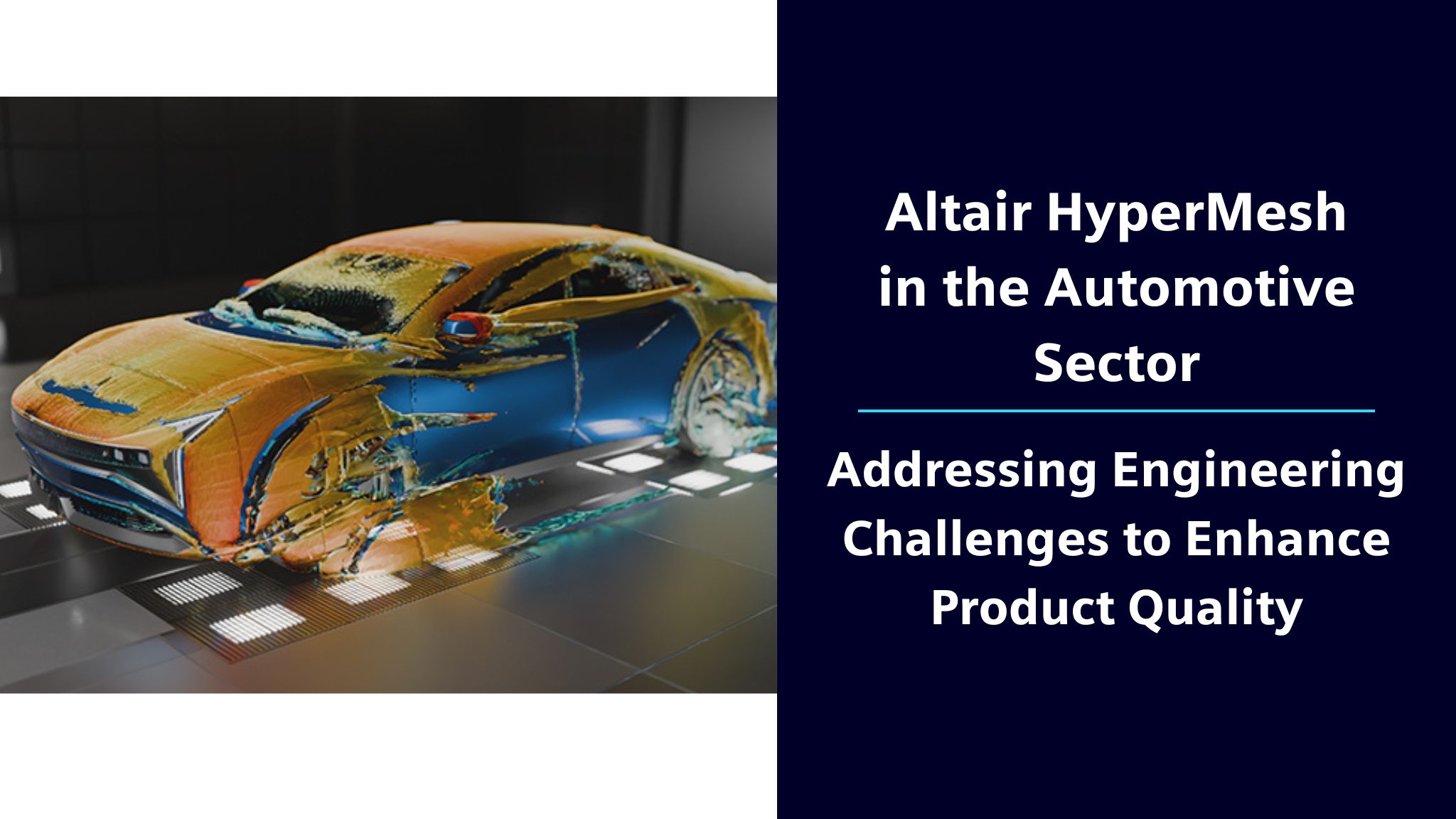
The automotive sector is experiencing a significant transformation fueled by electrification, lightweighting, safety regulations, sustainability objectives, and accelerated product development timelines. As vehicles grow increasingly complex—incorporating advanced materials, electronics, and software—engineering teams are under heightened pressure to produce high-quality, safe, and cost-efficient products within reduced timeframes.
Central to this challenge is Computer-Aided Engineering (CAE), where the precision and efficiency of simulations have a direct effect on product quality. Altair HyperMesh, a premier pre-processing and model-based engineering tool, is essential in assisting automotive manufacturers and suppliers in fulfilling these requirements by providing high-quality simulation models, quicker turnaround times, and enhanced design confidence.
Key Challenges in Automotive Engineering
1- Enhancing Model Complexity
Contemporary automobiles consist of numerous components—body-in-white, closures, powertrain, chassis, battery systems, and interior structures. The process of preparing simulation-ready finite element (FE) models from intricate CAD data is labor-intensive and susceptible to errors.
2- Reducing Weight Without Sacrificing Safety
Automakers are required to decrease vehicle weight to achieve fuel efficiency and electric vehicle range objectives while still adhering to rigorous crash and durability regulations.
3- Accelerated Development Cycles
The competitive landscape necessitates quicker design iterations and prompt validation, allowing minimal opportunity for manual, repetitive CAE tasks.
4- Interdisciplinary Simulation Needs
Automotive products must undergo validation for crashworthiness, noise, vibration, and harshness (NVH), durability, fatigue, thermal performance, and manufacturing impacts—often employing various solvers and workflows.
5- Consistency in Data & Accuracy of Simulations
Subpar mesh quality or inconsistent modeling methodologies can result in erroneous outcomes, postponed decisions, and expensive physical rework.
How Altair HyperMesh Addresses These Challenges
1- Premium Mesh for Precise Simulation
Altair HyperMesh is well-known for its sophisticated meshing features, allowing engineers to create uniform, solver-ready meshes for intricate automotive parts.
Impact on product quality:
- Enhanced correlation between simulation results and physical testing
- Minimized numerical inaccuracies
- More dependable forecasting of crash, durability, and NVH performance
2- Automation for Accelerated Model Preparation
Through batch meshing, templates, and scripting, HyperMesh streamlines repetitive tasks such as geometry cleanup, mesh creation, and quality assessments.
Advantages:
- Marked decrease in model preparation duration
- Quicker design iterations
- Increased focus on engineering analysis instead of manual tasks
This speedup directly contributes to shorter automotive development timelines.
3- Lightweight Design Enhancement
HyperMesh integrates effortlessly with Altair’s optimization tools, facilitating topology, size, and shape optimization early in the design process.
Outcomes for automotive teams:
- Decreased component weight
- Optimized material utilization
- Preserved or enhanced structural integrity
This guarantees that lightweight designs do not sacrifice safety or durability.
4- Multi-Solver & Multi-Discipline Compatibility
HyperMesh is compatible with all leading automotive solvers such as:
- OptiStruct
- Radioss
- Abaqus
- LS-DYNA
- ANSYS
Engineers can develop a single model and apply it across various analyses, ensuring data consistency in crash, NVH, durability, and fatigue simulations.
5- Enhanced Crashworthiness & Safety Verification
For crash and impact simulations, HyperMesh facilitates:
- Robust shell and solid meshing
- Precise contact definitions
- Efficient model assembly for comprehensive vehicle simulations
This results in:
- Improved crash prediction
- Fewer physical crash tests
- Increased occupant safety
6- Improved Durability and Fatigue Life Forecasting
HyperMesh guarantees superior mesh quality and appropriate connectivity, which are essential for the durability and fatigue assessment of automotive components.
Enhancements in quality encompass:
- Precise stress distribution
- Enhanced fatigue life predictions
- Minimized warranty and recall liabilities
7- Manufacturing-Conscious Simulation
HyperMesh accommodates manufacturing simulation inputs such as:
- Sheet metal forming
- Weld representations
- Composite layups
By taking manufacturing influences into account at an early stage, engineers can detect potential flaws and enhance manufacturability and product resilience.
Business Implications for Automotive OEMs & Suppliers
By utilizing Altair HyperMesh, automotive firms realize:
- Superior product quality and dependability
- Lower development expenses
- Fewer physical prototypes
- Accelerated time-to-market
- Enhanced adherence to global safety regulations
HyperMesh facilitates a transition from reactive problem-solving to predictive, simulation-based design.
Conclusion
In a time when automotive advancement relies on speed, safety, and sustainability, Altair HyperMesh emerges as a vital enabler of high-quality product development. By tackling significant engineering obstacles—complexity, lightweighting, precision, and time limitations—HyperMesh empowers automotive teams to confidently design superior vehicles.
Through exceptional meshing, automation, solver adaptability, and optimization features, Altair HyperMesh significantly enhances product quality, boosts safety, and accelerates innovation throughout the automotive sector.