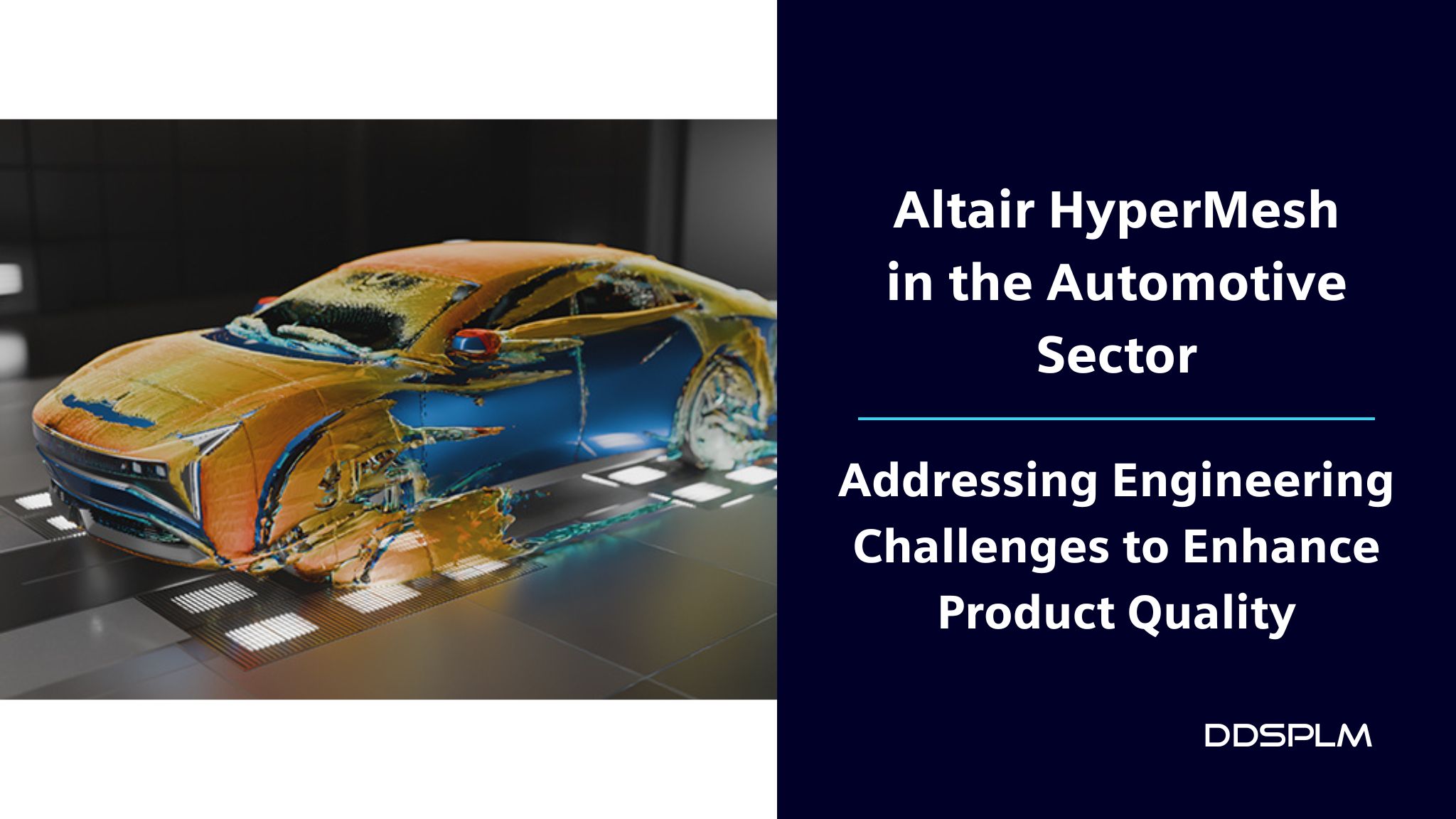
The automotive industry is undergoing a major revolution due to electrification, lightweighting, safety standards, sustainability goals, and a faster product development process. With the increasing complexity of vehicles considered in terms of materials, electronic and software innovations, engineering departments are now under intense pressure to create quality, safe and cost effective products within shorter timeframes.
The key element to this dilemma is Computer-Aided Engineering (CAE), in which the accuracy and effectiveness of simulations directly influence the quality of products. Altair HyperMesh is a leading pre-processing and model-based engineering software, which plays a significant role in helping automotive manufacturers and suppliers to meet these needs by offering better simulation models, faster turnaround, and design confidence.
Major Issues of Automotive Engineering.
1- Enhancing Model Complexity
Modern cars are made up of many parts, which include body-in-white, closures, powertrain, chassis, battery systems and interior structures. Simulation-ready finite element (FE) model preparation from complex CAD data is a tedious task that is prone to mistakes.
2- Lightweight vehicle
A manufacturer has to reduce the weight of vehicles to pursue the goals of fuel efficiency and electric car range without violating strict crash and durability standards.
3- Rapid Product Delivery.
Competitive environment requires faster design cycles and immediate validation, which leaves very little time to do everything manually and then to repeat a CAE process.
4- Multidisciplinary Simulation Requirements.
The automotive products should be subjected to crashworthiness, noise, vibration, and harshness (NVH), durability, fatigue, thermal performance (and manufacturing impacts)- sometimes using different solvers and workflows.
5- Data Coherence and Precision of Simulations.
Poor mesh quality or variant of inconsistent modeling approaches may lead to incorrect result, delay in making decisions and costly physical reworking.
The ways Altair HyperMesh Overcomes These Problems.
1- Premium Mesh to be used in Simulation.
The Altair HyperMesh is reputed to have advanced meshing tools that enable the engineering community to make homogenous solver ready meshes of complex automotive components.
Impact on product quality:
- Improved correlation of physical testing and simulation results.
- Reduced number errors.
- Greater reliability in predicting crash and durability as well as NVH performance.
2- Automation of Accelerated Model Preparation.
HyperMesh simplifies the repetitive processes used to clean up the geometry, create the mesh, and test meshing quality through batch meshing, templates and scripting.
Advantages:
- Reduction in model preparation time significantly.
- Quicker design iterations
- More attention to engineering analysis, rather than manual work.
This acceleration is one of the direct reasons behind the reduction of automotive development cycles.
3- Lightweight Design Enhancement.
HyperMesh can be used with the optimization tools of Altair and used to optimize the topology, size, and shape of the intelligent structure at the beginning of the design.
Deliverables of the automotive teams:
- Decreased component weight
- Efficient usage of material
- Remaining or improved structural integrity
This also ensures that lightweight designs are not compromised on safety or durability.
4- Multi-Solver & Multi-Discipline Compatibility.
HyperMesh will work with all major automotive software solvers including:
- OptiStruct
- Radioss
- Abaqus
- LS-DYNA
- ANSYS
The engineers can create one model and use it in different analyses, and the data will be the same in crash, NVH, durability, and fatigue simulation.
5- Improved Crashworthiness and safety check.
In case of crash and impact simulations: HyperMesh eases:
- Strong shell and solid meshing.
- Accurate definitions of contacts.
- Computational assembly of vehicles on a large scale.
This results in:
- Improved crash prediction
- Fewer physical crash tests
- Increased occupant safety
6- Better Fatigue Life and Durability Prognostication.
HyperMesh ensures high quality of the mesh as well as proper connectivity that is important in the fatigue and durability of the automotive parts.
Improvements in quality include:
- Accurate distribution of stress
- Optimized predictions of fatigue life
- Reduced warranty and recalls
7- Conscious Simulation-Transformation of the manufacturing process.
HyperMesh has the capability to include manufacturing simulation inputs that include:
- Sheet metal forming
- Weld representations
- Composite layups
Considering the influences of manufacturing at the initial stage, engineers will be able to identify possible flaws and improve manufacturability and product resilience.
Automobile OEMs and Supplier Business Implications.
With the help of Altair HyperMesh, automotive companies achieve:
- High quality of products and reliability.
- Lower development expenses
- Fewer physical prototypes
- Accelerated time-to-market
Improved compliance with world safety standards.
HyperMesh helps in making a shift to predictive, simulation-based design as opposed to reactive problem-solving.
Conclusion
Altair HyperMesh has become a critical facilitator of high-quality product development in a modern-day where automotive development is based on speed, safety, and sustainability. HyperMesh provides an answer to major engineering challenges that are faced by automotive organizations such as the difficulty of engineering complicated designs, lightweighting, precision, time constraints, etc.
Altair HyperMesh is a powerful tool to improve the quality of products, increase safety, and speed up innovation across the automotive industry due to the features of exceptional meshing, automation, solver flexibility and optimization.