
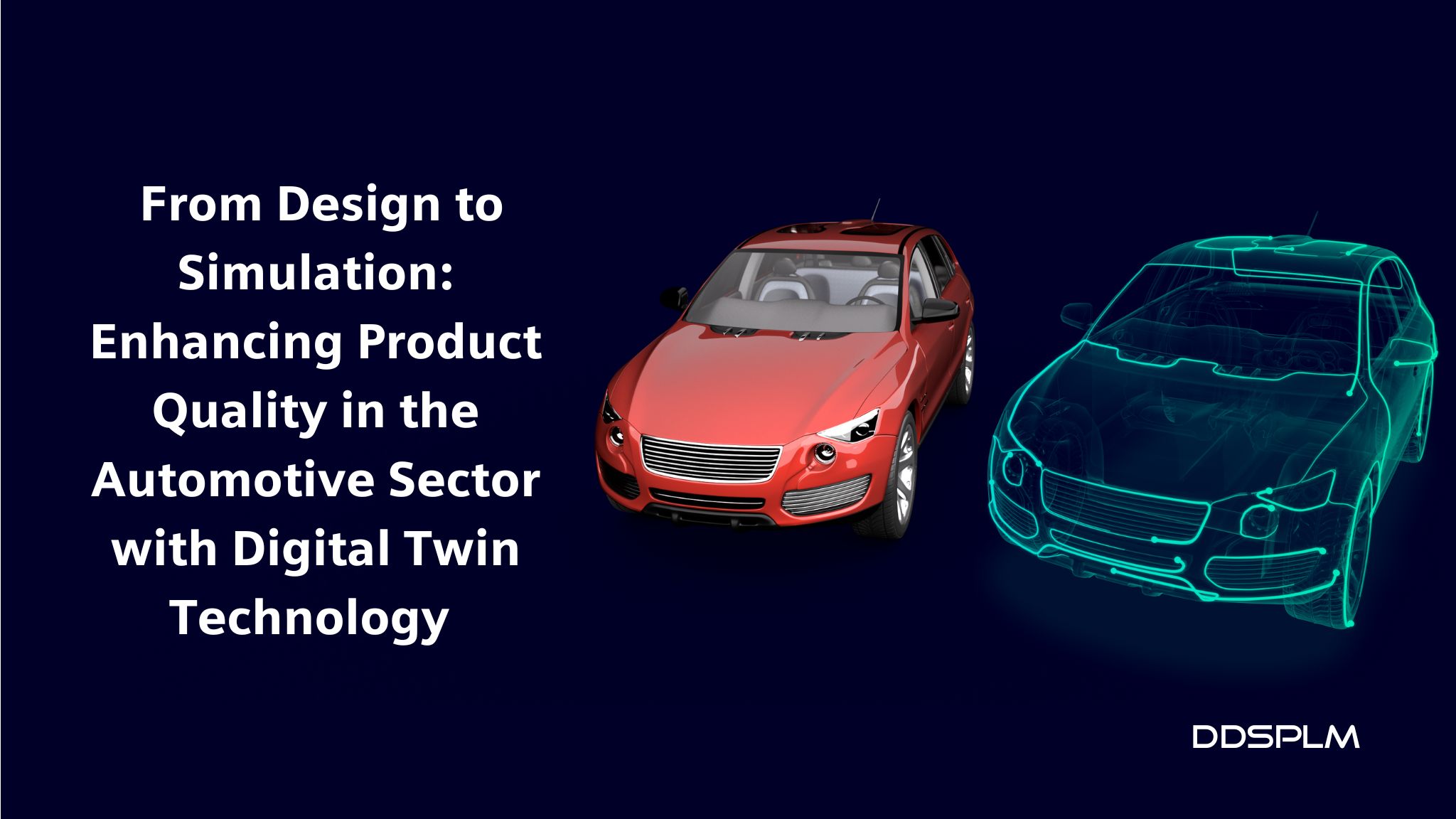
A major change in the Automotive Industry that is being catalyzed by electrification, lightweight materials, safety regulations, sustainability goals, and the pursuit of a faster time-to-market is being felt. A modern car is not a simple mechanical object anymore, it is a complex reflection of a combination of structures, electronics, software, thermal systems, and technology.
The traditional design and validation systems that rely on the use of physical prototypes and testing only at the end stages cannot keep pace with such complexity. In order to keep up with competition, auto industry players are moving to design-to-simulation processes that take advantage of the Digital Twin technology.
Design, simulation and testing integrated at the very beginning of the development process will allow the automotive companies to predict the performance in the real world, reduce risk and have an enormous impact on the quality of a product.
Important Issues in the Product Development of the automotive industry.
1- Raising Product Complexity
Modern vehicles encompass:
Lightweight (aluminum, composite, and plastic) materials.
Advanced powertrains (such as electric vehicle, hybrids, hydrogen and so on)
Autonomous and functionalities.
Complex thermal and fluidic systems.
The conventional techniques of handling the relationship between these systems often leads to late design changes and quality issues.
2- Lengthy Testing Periods and expensive prototyping
It is unwise to only rely on physical testing as:
- Time-intensive
- Costly
- Limited in the exploration of design.
A lot of prototype designs delay the innovation process and make development costs high.
3- Problems with Quality Diagnosed Late
Various problems like NVH, durability problems, thermal hotspots and airflow inefficiencies tend to be detected very late in the testing or production process and lead to:
- Rework
- Delays
- Overruns
- Degradation
- Dissatisfaction
4- Sustainability & The Control Pressure.
The manufacturers of autos must comply with:
Regulations on safety and emissions.
Noise and vibration requirements.
Energy conservation and sustainability goals.
These standards, when coupled with a low weight and low cost, are a tremendous engineering challenge.
Simulation to Design: A Smarter Engineering Method.
Design-to-simulation process is a combination of CAD, CAE and system simulation into one continuous workflow. Simulation is not a last step validation step but is incorporated as a part of design decision making.
This approach allows the engineers to:
- Test the performance at an early stage.
- Research on different design solutions.
- Improve products before the physical prototypes are present.
- The key component of this methodology is the Digital Twin.
What is a Digital Twin in the Automotive Engineering?
Digital Twin is an imaginary version of a physical product, a predictor of the actual performance of the product in its life cycle.
A Digital Twin incorporates in the context of the automotive development:
- 3D CAD geometry
- Multiphysics simulation (Structural, thermal, CFD, NVH and durability).
- System-level simulation (1D)
- Test and validation data
This leads to the creation of a unified, stable model that carries out of the concept design phase to production and on to in-service performance.
Improving the Quality of Automotive Products using Digital Twin.
The first stage in the process of performance validation is the early one, wherein the vendor undergoes an initial performance evaluation in accordance with the specifications and contract terms (Baskerville 1995, p. 45).<|human|>The first step in the performance validation process is the early one where the vendor is subject to an early performance test in line with the requirements and the terms of the contract (Baskerville 1995, p. 45).
With the application of Digital Twin-based simulation, engineers can evaluate:
Structural integrity and preventive crashworthiness.
- Electronic components and thermal efficiency of batteries.
- Dynamic of aero and airflow
- NVH levels Noise, vibration and harshness.
- Laws of durability and fatigue.
Design issues are identified at an early stage when the changes are quicker and cheaper to implement.
Physical Prototypes Diluted.
Simulation based design has the potential to reduce physical prototype requirement by 30-60 percent and help manufacturers:
- Reducing expenses
- Fastening development schedules.
- Focusing physical testing on final testing
Simulation and testing are joined together to constantly improve the Digital Twin to make it more accurate.
3- Better Design Optimization.
The Digital Twin enables the engineers to:
Get comparisons of different design options.
Achieve both weight, strength and performance optimization.
Trade-offs between cost, safety, efficiency and sustainability.
This ends up creating vehicles that are lighter, stronger and more efficient.
4- Greater Good First-Time-Right Quality.
Through virtual approval of designs:
The problems in manufacturing are detected earlier.
The assembly problem is reduced to a minimum.
Less changes are implemented in the production.
This improves the yield of the first pass, reduces wastage and the general quality of the product.
5- Improved Inter-team cooperation.
A Digital Twin provides a single digital thread between :
- Design engineers
- CAE analysts
- Manufacturing personnel
Quality assurance and testing departments.
The current data is used by all parties, which enhances communication and decision-making. More Compliance and Reliability.
Simulation-based validation ensures:
The regulatory standards are met early in the process.
Digital validation of safety margins is done.
The durability is long-term and it is well forecasted
This reduces the number of recalls, warranty costs and compliance issues
The Actual Effect of Digital Twin Technology in the Automobile industry.
OEMs and suppliers of automotive designing to simulate workflows have reported:
25-40 percent reduction in development cycles.
A significant reduction in design changes at the end of the process.
High Noise, Vibration and Harshness (NVH) and better ride comfort.
More electric vehicle (EV) efficiency.
High quality thermal control and safety.
The Digital Twin becomes a strategic asset as opposed to a simulation model.
Conclusion: The Future of Automotive Quality Lies in Digital
With more and more complexity in automotive products, and an increase in the rate of innovation, traditional development approaches are becoming unhelpful. Digital Twin technology has led to the integration of design-to-simulation which is changing the engineering, validation and optimization procedure of vehicles.
With simulation built-in at the initial phase, its connection with design, and testing, and a continuous Digital Twin, automotive manufacturers will be able to:
- Enhance product quality
- Minimize risk and costs
- Speed up innovation
- Offer smarter, safer and more sustainable cars
Digital automotive engineering starts with the Digital Twin and is the future of the engineering field.